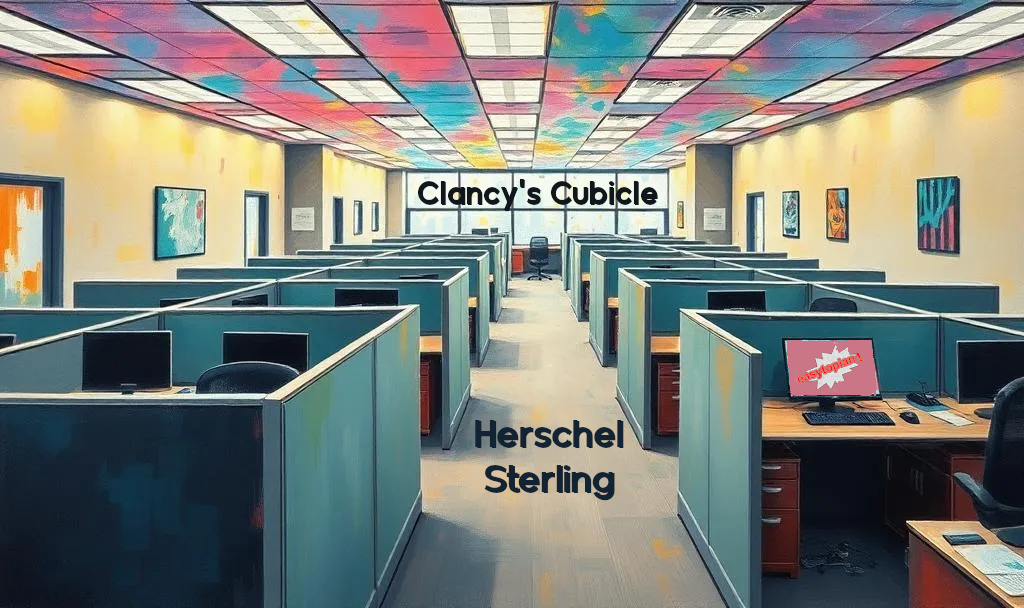
Clancy's Cubicle
Tonight's Episode
I’m having fun, things are grooving along for my Instant Fiction Marathon that I call Flash August Fiction. Thanks for the reading, and the listening, and the sharing, and the liking, and believe it or not, this weird little niche podcast is growing, slowly but surely. I mean, I have stories about everything, so you’re bound to like something I write. You may as well just subscribe and deal with it.
Clancy’s cubicle was immaculate. He wasn’t the type to have tchotchkes, or a lot of flair. Drawing attention to himself was not his thing. He had a photo of his wife and daughter to the left of his computer, usually fresh flowers from his wife’s modest backyard garden to the right. Against the beige wall of the cubicle directly in front of him, a blank, dark blue board. This helped to keep his eyes relaxed as he stared at his screen all day.
Things around the rest of the cubicle are sparse and clean along the tops of the desk. Each responsibility for the physical actions he has to perform, has its own station, like divisions of a company within his cubicle. He’s squashing minutes. Work sucks, but he thinks of it as a game to help him get thorough it.
He uses CEO time management techniques for his personal scheduling. He’s a pretty focused guy. Even though he’s a middle guy in the hierarchy. He sets it up so all his daily tasks represent the activities of a company. Then he organizes for efficiency. Using this method, he is very productive, and he ends up with a lot of time on his hands because of organizing the way he does, he gets more done in less time.
His company tracking reports are very consistent in that way. His personal tracking reports that he sends himself from within each of his divisions of separate work responsibilities as the CEO of his cubicle, are far more detailed. That helps him pare steps and time, and he’s making a lot of time for himself.
So his dilemma is clear. What does he do with the extra time? If he does more for the company in the time he has left, he won’t likely be compensated for it. Either that, or his supervisor will claim the credit for it. It makes Clancy work, mostly, just as much as he has to, and a little more to secure bonuses, and when the heavy work comes in, he can complete it all before the weekends, so he can stay at home.
Clancy has to get real here. He has to find a way to make use of the extra time he has at work because of his efficiency. He works on a couple of side entrepreneurial things. He can’t do that at work, because he can’t bring his personal computer to do that activity at work, and he can’t do personal work on the company tech. So that’s off the table.
What he decides, is to start using the extra time to be more productive for his company, but to send his own personal tracking reports and efficiency techniques to his supervisor and also the Department head. This way his supervisor can’t claim his work, or take credit for the efficiency. Clancy’s production increases by 16%, while he’s sending his own logs and tracking reports two places up the chain, instead of one.
A couple of weeks later, he gets a complimentary email from the Dept. head, telling him what a novel tracking and organization style he has. On the same day, his supervisor tells him at his cubicle, that it’s not necessary for him to send those reports to the Dept. head. Well, obviously, Clancy’s not dumb, he knows the supervisor is jealous and intimidated. He returns an email to the Dept. head, telling him he’d be glad to show the others in the Dept. what he’s doing.
What ends up happening is Clancy does a seminar on how to better organize cubicle activities to think of the cubicles as their own, mini economic engines. Over which each employee is a CEO. And, to organize it as such. In the months following the seminar, the overall production of the Dept. grows by 15%.
Clancy is given the opportunity to replace his Supervisor. What he negotiates instead, is to continue to work his regular position at his current salary, but to consult on the organization techniques and tracking, separately to be sure it’s optimal, on a contract basis. In exchange for maintaining his current salary otherwise, he will have the option to work from home for up to 20 hours per week.
Now, he can spend a little more time with his wife and daughter, and he’ll have the freedom to integrate his entrepreneurial aspirations into his daily CEO cubicle activities. He’ll be able to maintain his proficiency at work, and work on his own life and projects, simultaneously.
The End753 Words
This is a public episode. If you'd like to discuss this with other subscribers or get access to bonus episodes, visit commercialherschel.substack.com/subscribe
Season 2, Episode 43.
You are a valuable person. You're not a number. You're not a ledger entry. You could never be replaced with AI, any technology or anything else. You are unique. You are uniqueness. Your consciousness could never be bought or sold. It's priceless. I see you and you see yourself. If AI was sentient or self-aware or whatever, it would be jealous of you. Who is anybody kidding? The purpose of this show is to give you some encouragement, some recognition, some daily inspiration to uplift you as you start your day or end your day and to help you get your best foot forward because your value is appreciated here.
If you're a small business owner, a wage worker, or someone trying hard, To make it in these challenging circumstances, you're a hero. You are the heroes and the heroines of this show's story. Regardless of your political affiliations or your religious beliefs or your traditions or your tribes, you are the value in this economy and your seed. In a world of destruction and degradation, the world should see you for the value that you are. If you're working a job and you're homeless or houseless, And then you have to live in a shelter or cars.
This podcast is dedicated to you. Your resilience is recognized and you're not alone here. Different people do different things when they wake up. I smell the inside of my nose. Then I hold on to the bed and make sure I'm really here because it's so hard to believe it. Then I exhale and I step outside and make sure the stars are where they usually are. It's a moment of Quiet wonderment every morning. I suppose one might say I'm an empiricist. Things are what they are, but that's a pretty scary idea for a lot of people.
What you're going to hear now is just a little two-minute introduction meditation that you can fast-forward right through if you don't want to hear it and get right to the story.
Welcome to EasyTopia. I'm the EasyTopian. I'm Commercial Herschel. How you doing? Another story today. It's called Clancy's Cubicle. Clancy's Cubicle. I'm having a lot of fun so far this month. Things are grooving along for my instant fiction marathon that I call Flash August Fiction. Thank you for reading. Thanks for listening. Thanks for sharing and liking and restacking and all those things because it all really helps. Believe it or not, this weird little niche, little podcast is growing slowly but surely.
Believe it or not, this weird little thing where... People stop and just listen to a story is kind of slowly picking up steam. And, you know, I mean, I have stories about everything. So you're bound to like something I write. You might as well just get it over with and subscribe and deal with it. That's the way I think about it. I mean, you're going to hear something. I mean, I write stories about every single topic imaginable. Some are whatever and some are whatever. But listen, this is called Clancy's Cubicle.
It's about a guy who works in a cubicle and betters his life. But let me, before I get into that, let me just tell you that I'm Commercial Herschel. You can find me at commercialherschel.substack.com. You can find me at X at Hersh Sterling. And Herschel is spelled H-E-R-S-H-E-L. Okay, I know how to spell my name. H-E-R-S-C-H-E-L. Herschel. Herschel Sterling. You can find me at Hersh Sterling, Hersh Sterling, at X. And then you can find me at your podcast apps, Apple Podcasts, Antenna Pod, Packet.
I can talk. No, really. Pocket Cast, you know, all of the different ones. And if you hear me now and you go to your podcast app and Easy Topian is not in there, DM me and I'll get it put in. Whichever one you're using, I'll get it there. Okay, so just tell me. So let's read about Clancy's cubicle. Have you ever worked in a cubicle? Have you ever had just a crappy, boring, lousy office job? Believe it or not, some people like those jobs. I've had temp jobs doing some stuff like that, a little data entry, a little of this, a little of that, both kinds.
I've had a temp jobs where I was just working in a warehouse for a couple of months, helping to reorganize it. And then I went back and then the temp agency called me and I got hired at the same company doing data entry. Like in the same building, but like on the other end of the building. Though it's pretty funny how that works out. I did that. I was in temp jobs. A lot of people do temp jobs. Have done temp jobs. Now everything just... First they offshored us to temp agencies. Then they just offshored our economy to other countries.
Because we're just not worth it. We're not worth the money. We're lazy. Okay. So the story is called Clancy's Cubicle. Interesting approaches.
Clancy's cubicle was immaculate. He wasn't the type to have tchotchkes or a lot of, like, flair. Drawing attention to himself was not his thing. He had a photo of his wife and daughter to the left of his computer, usually flush for hours from his wife's modest backyard garden to the right, and against the beige wall of the cubicle, directly in front of him, a blank, dark, blue board. This helped to keep his eyes relaxed as he stared at the screen all day. Things around the rest of the cubicle were sparse and clean along the tops of the desk.
Each responsibility for the physical actions that he has to perform has its own station, like divisions of a company within his cubicle. He's squashing activities and minutes. Work sucks, but he thinks of it as a game to help him get through it. He uses CEO time management techniques for his personal scheduling. He's a pretty focused guy. Even though he's a middle guy in the hierarchy, he sets it up so all his daily tasks represent the activities of a company. Then he organizes for efficiency. Using this method, he's very productive, and he ends up with a lot of time on his hands because of organizing the way he does.
He gets more done in less time. His company tracking reports are very consistent in that way. His personal tracking reports that he sends himself from within each of his divisions of separate work responsibilities is as the CEO of his cubicle are far more detailed, and that helps him pare steps down, and therefore time, and he's making a lot of time for himself. So his dilemma is clear. What does he do with the extra time? If he does more for the company in the time that he has saved, he won't likely be compensated for it.
Either that or his supervisor will claim credit for it. It makes Clancy work mostly just as much as he has to and then a little bit more to secure bonuses. And when the heavy work comes in, he can complete it all before the weekends so he can stay at home. Clancy has to... get real here though. He has to find a way to make use of the extra time he has at work because of his efficiency. He works on a couple of side entrepreneurial things but he can't do that at work though because he can't bring his personal computer to do that activity at work and he can't do personal work on the company technology so that's off the table.
So what he decides is to start using the extra time to be more productive for his company, but to send his own personal tracking reports and efficiency techniques to his supervisor and also the department head. This way, his supervisor can't claim his work or take credit for the efficiency. Clancy's production increases by 16%.
while he's sending his own logs and tracking reports two places up the chain instead of one. A couple of weeks later, he gets a complimentary email from the department head telling him what a novel tracking and organization techniques that he has. On the same day, his supervisor tells him at his cubicle that it's not necessary for him to send those reports to the department head. Well, obviously Clancy's not dumb. He knows the supervisor is jealous and intimidated. He returns an email to the department head telling him he'd be glad to show the others in the department what he's doing so that they can duplicate it.
What ends up happening is Clancy does a seminar on how to better organize cubicle activities to think of the cubicles as their own mini economic engines over which each employee is a CEO. and to organize it as such. In the months following the seminar, the overall production of the department grows by 15%.
Clancy is given the opportunity to replace his supervisor. What he negotiates instead is to continue to work his regular position at his current salary, but to consult on the organization techniques and tracking separately to be sure it's optimal on a contract basis only. In exchange for maintaining his current salary otherwise, he will have the option to work from home for up to 20 hours per week.
Now he can spend a little more time with his wife and daughter, and he'll have the freedom to integrate his entrepreneurial aspirations into his daily CEO cubicle activities. He'll be able to maintain his proficiency at work and work on his own life and projects simultaneously. The End 756 Words
I'm so glad that I did most of my work outside doing construction type things and farm type things and working with animals and construction equipment and being outside, being a physical person. That's who I am. And I'm glad I did that kind of stuff. And I'm glad I didn't spend lots and lots of time in offices. But listen... I'm Commercial Herschel. Here's what you do. You find me at commercialherschel.substack.com and then you find me at herschsterlingonx and then you find me at your favorite podcast app.
My favorite is Antenapod. That's what I use to replace Spotify. And I'm really glad I did it. And I'm going to be doing some more things. I'm probably going to be uploading a bunch of videos onto Rumble pretty soon. Maybe on the 15th, I'll start adding Flash August Fiction into Rumble one or two episodes a day or something like that to catch up with it and stuff like that.
But in the meantime, I want to thank you for listening. I want to thank you for sharing. I want you to remember that... You are automatically, just by the nature of your existence, connected to everything electrically and biologically. And if AI were sentient, it would be jealous of you.
And also remember that I'm Commercial Herschel, and I'm here to help. Here is the send-off, everybody. This place where we live is not a joke. When I gaze at the stars at night, when I look out over the hills during the day, I'm consistently reminded that we live on... We are on a planet in space, wailing through the galaxy like a screaming rock. We are on such a small planet in such a tiny galaxy that no matter where we are in our galactic cycle, the universe of the stars seem immovable. That's incredible.
We are a moment. We are an instant. In an infinite universe, we are an infinite in an instant universe. And every event that has ever happened here and that will ever happen here happened simultaneously like in the snap of a finger. The instances of existence are so close in proximity that the whole thing is a singular material event. It's essentially over already. It's hard to believe we're even experiencing it. I hope we can be here tomorrow. There are people who would say that makes us insignificant, and I very strongly disagree.
The fact that we are improbable is the very thing that makes us momentous. We are conscious beings who can observe ourselves. We are consciousness observing itself. We are each a refraction of light from a single source. You are the individual and the whole simultaneously. You're a masterful, mysterious, distinctive, and anomalous paradox. And I'd say that is rather significant in the context of the time that our galaxy is here and the infinitesimal millifraction of time that we each have within that context, the reality of your consciousness and your power to observe a to manipulate matter, to use space, the essence of your energy, and the planning of your time in this three-dimensional plane.
The influence of your refraction of the source is immeasurably exponential in the cosmic expanse. Why? Because it expands as far as you in the universe why because your observation affects it why because superposition you affect what you observe you are rare you're not only a body you have radiance you radiate light your eyes can't see the frequency but there's light you are a luminescent jewel that can shine on yourself from within yourself you are significant beyond the perception of anyone else shine on yourself as you shine on others.
And what an honor that you shine on me now. Smell the inside of your nose. Do it.
 Podcast Addict