How Plato Relates to Dragons
Tonight's Episode
Flash August Fiction is coming! Please join me for that!
What is flash fiction. FFF.
Several mechanisms.
These are my notes. It’s not the transcript.
The other morning, the bird that lives outside my window was talking. It sounded a lot like he said “National Geographic.” That’s weird. When I wake up, I write about whatever is on my mind first thing. My podcast is based on that.
What I did that day was go to the NG website to see what was there. There were a lot of stories about different things. Dragons and Tornadoes and Volcanoes and just all the stuff you find at NG. None of it really caught my fancy, so I didn’t write any of it, but I think it’s cool that this bird makes such sophisticated noises that it sometimes sounds like human speech.
Now what happens is every time I hear him it reminds me to write, but first I listen to him, in case I hear any human sounding words. That could be a good impetus, or inspiration to write something.
I do my FF and all other stuff that comes out of that. Here are some links for that stuff.
Today is not a FF story, I want to just do a little riffing off of one of my favorite reads. Ted G did a cool article about Plato and Socrates. I have my own ideas about Plato and Socrates, not totally out of line with his.
Whenever I think of Plato and Socrates I think of the song Chrissie Hynde wrote with the Pretenders. “Kid”.
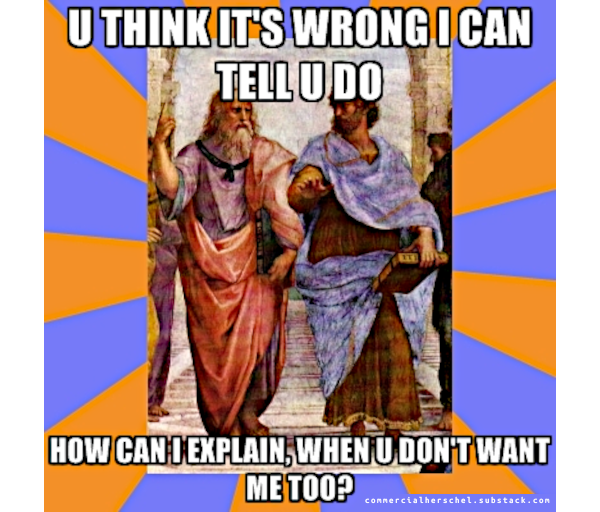
YOU THINK IT'S WRONG,
I CAN TELL YOU DO.
HOW CAN I EXPLAIN
WHEN YOU DON'T WANT ME TO?
But It’s not Socrates talking to Plato, it’s Plato talking to Socrates, posthumously. If you know the origin of that song, you’ll get me here.
Here is the writing by Ted Gioia about how to read Plato.
This is a public episode. If you'd like to discuss this with other subscribers or get access to bonus episodes, visit commercialherschel.substack.com/subscribe
SPEAKER_01: Episode 110.
SPEAKER_01: Flash Fiction August is coming. I hope you'll join me. Here's the introduction to my podcast that lasts about two minutes. You can just fast forward through it if you don't want. It's kind of a meditation. I hope you enjoy it. You are a valuable person. You're not a number. You're not a ledger entry. You could never be replaced with AI, any technology, or anything else. You are unique. You are uniqueness. Your consciousness could never be bought or sold. It's priceless. I see you and you see yourself.
SPEAKER_01: If AI was sentient or self-aware or whatever, it would be jealous of you. Who is anybody kidding? The purpose of this show is to give you some encouragement, some recognition, some daily inspiration to uplift you as you start your day or end your day and to help you get your best foot forward because your value is appreciated here. If you're a small business owner, a wage worker, or someone trying hard to make it in these challenging circumstances, you're a hero. You are the heroes and the heroines of this show's story.
SPEAKER_01: Regardless of your political affiliations or your religious beliefs or your traditions or your tribes, you are the value in this economy and you're seen. In a world of destruction and degradation, the world should see you for the value that you are. If you're working a job and you're homeless or houseless, and then you have to live in a shelter or cars, this podcast is dedicated to you. Your resilience is recognized and you're not alone here. Different people do different things when they wake up.
SPEAKER_01: I smell the inside of my nose. Then I hold onto the bed and make sure I'm really here because it's so hard to believe it. Then I exhale and I step outside and make sure the stars are where they usually are. It's a moment of quiet wonderment every morning. I suppose one might say I'm an empiricist. Things are what they are, but that's a pretty scary idea for a lot of people. Alright, yeah, like I said, Flash Fiction August is on the way. Today I'm writing about a thing about Plato and I was inspired by this guy Ted, I don't know how to say his last name, you gotta forgive me for that.
SPEAKER_01: It's pronounced, it's spelled G-I-O-I-A. So it's Gioia, Gioia, I think it's Gioia. I think you say Gioia, Ted Gioia. And he's got a sub stack. Ted is one of the best writers I've ever written. He's one of the best thinkers of my generation. And he very clearly, unlike me, does not have ADD or ADHD or whatever you call it. I mean, this guy is a very good thinker, one of the best thinkers ever. of our generation, and so he's in my podcast here. I put him in the body of the podcast, as I mentioned, with the link to the article that kind of inspired me to write this thing about Plato that I've been wanting to say, but Flash Fiction August is 30 stories in 30 days.
SPEAKER_01: I write a new story every day, then I produce a podcast and make a little image to go with it, and then upload the podcast. And I did the same thing in February, Flash Fiction February, but I'm calling this Flash August Fiction. I think it sounds better than Flash Fiction August. But you can call it Flash Fiction August if you want. I don't care what you call it. But I'm doing it, and I hope you'll join me, and I hope you'll subscribe to my podcast. I think it's worth subscribing for. I mean, I think it's worth paying me five bucks to do it.
SPEAKER_01: But if you want to listen to Flash Fiction February, that's now behind a paywall. So you're going to have to pay for that if you want to check out some of those stories. It was a lot of fun for me. It's a great writing exercise. And I'm going to get more into that. But there's so many different mechanisms for writing. So let me explain how this podcast came about. The other morning, there's a bird. It lives outside my window. And the other morning, it was talking. And this is one of those warblers that has got very sophisticated vocal cords.
SPEAKER_01: It sounds almost like human talking sometimes. It's like another language. I can't understand it. But like, It sounds like it's making syllables and like doing the whole thing. And it sounded a lot like he was saying National Geographic, National Geographic. I heard National Geographic, National Geographic. It's so weird. And so when I... When I wake up in the morning, I write about whatever I dreamt about or whatever the first thought in my mind was. But that was the first thing I heard. And so I said, I better go look at the National Geographic website.
SPEAKER_01: So I went to the National Geographic website to see what was there. And there were a lot of stories about all kinds of different things. The first story right at the top of the page was about dragons. And I slay dragons. I don't know. You don't know that about me. But as when I was in younger years, when I was involved in my citizen volunteerism, I destroyed the careers of really corrupt people. That was one of the things that I did. And I slay dragons. And I think I have more dragons to slay. So I thought that was cool that I saw the dragons.
SPEAKER_01: So there were stories about dragons and tornadoes and volcanoes and all kinds of treacherous stuff that day on National Geographic that morning. All the kind of stuff you see at National Geographic, really. But none of it really caught my fancy. I didn't want to write about any of it, so I didn't write about any of it. But I think it's cool that this bird makes such sophisticated noises that sometimes it sounds like human speech. Now what happens every time I hear that bird out there, it makes me think about writing.
SPEAKER_01: It makes me think about what I need to write about. So now I have yet one more thing to remind me, to prod me, to keep me writing. But first I listen in case I hear any human-sounding words. So anytime he sings now, I hear him out there talking. I listen intently to see if he's telling me something. And so a lot of flash fiction comes out of that sort of thing. This isn't a flash fiction story today. This is more of just a theoretical thing, and it's more about me trying to get people prepared for Flash August Fiction and have people subscribe to my Flash Fiction February.
SPEAKER_01: 29 stories in 29 days. That's what I did in February of 2024. Now it's getting ready to be August of 2024, and it's going to be 30 brand new stories in 30 days. Please, I hope you'll join me for it. I hope you'll just every day, oh, Herschel just did another flash fiction for August. I want to hear his story today. You can listen to the meditation or fast forward through the meditation and then just go right to the story and then you'll hear the send off or that could just be the end. But I want to do a little riffing off of one of my favorite reads.
SPEAKER_01: Ted Joya did a cool article about Plato. and Socrates. And I'm not going to get all into that because it's there. I mean, you can go find it. All you got to do is come to my Substack, commercialherschel.substack.com, commercialherschel.substack.com. You'll find this podcast title and it's called you know, how Plato relates to dragons. Okay. And then you'll see Ted's link in the, you'll see Ted's link in there. So now here, whenever I think of Plato and Socrates, I think about the song that Chrissy Hind wrote with the pretenders called Kid and And that song is weird.
SPEAKER_01: I mean, it's not weird. It's the best song that I think she ever wrote. And that Pretenders lineup, that first Pretenders lineup, in my opinion, is the best rock lineup in the history of rock music. Those guys were the best. And it's so sad that they lost two of them so early in that career because the stuff that they would have done together is amazing. Those guys, that lineup was amazing. Chrissy Hynde is one of the greatest writers, greatest lyricists. And the song Kid is about a mom, and she's singing to her child who is old enough to understand what she does for a living and how she gets money for the family, how she makes money to make sure she can raise her child.
SPEAKER_01: Okay, and so it's kind of sad in a way, but it's also very realistic. And the reason I always think about that song between, that Chrissy Hynde wrote with the Pretenders, and I always think about Plato, is because I don't think of it as Socrates singing to Plato. You see, Plato was Socrates, one of his protégés. But I think of it as Plato singing to Socrates posthumously. Socrates was cancelled because he told the truth a lot and he encouraged young people to question authority. So he was slandered and financially ruined.
SPEAKER_01: he died in prison and the only thing that he could get out of the people on the outside was someone to pass him some hemlock so that he could commit suicide because he wasn't going to give the state he wasn't going to give the government the privilege of taking his life so he did it himself it's very sad story but he was kind of like you know something like a A truth teller of his day, a person who told the truth about the empire and about the oligarchy of his day. And they punished him for that.
SPEAKER_01: And Plato didn't want that to happen to him. So Plato wrote The Republic. And the lyric, you think it's wrong, I can tell you do. How can I explain when you don't want me to? But it's not Socrates talking to Plato, it's Plato talking to Socrates posthumously. So if you know the origin of that song, like I told you the meaning of that song. You'll get it. But Socrates was canceled and Plato was virtue signaling. Plato was a virtue signaler. Let me explain what I mean. Like I told you before, Socrates was canceled because he told the truth.
SPEAKER_01: He told the truth about the oligarchy. He encouraged the young people to question authority, to question everything, and to use what we call today Socratic method. And there's a lot about Socratic method in the Tejoia. article that I really encourage you to read, and I encourage you to subscribe to Ted. He's just one of the best thinkers and the best writers of our time, and he loves to write about art he writes about, music he writes about, other kinds of art. He's a good, good writer. And again, unlike me, does not have ADHD or whatever.
SPEAKER_01: So why was Plato virtue signaling when he wrote The Republic? The Republic is basically a big, gigantic book convincing the wealthy aristocracy to lay off of Plato because that book basically says that it's necessary for there to be an untalented, unskilled, non-practical aristocracy, a group of people who did not earn their wealth, who did not earn their power. They're born into their power, but they're necessary to run society. And then he goes on into pages and pages, thousands and thousands of words of minutiae on how to do it and how to make sure that it stays and it maintains itself.
SPEAKER_01: So he's basically, you know, saying to the wealthy people of his day who knew that he was a protege of Socrates, please don't kill me. Look, I'm writing a whole book. I'm writing a whole book saying how important you are, how necessary you are, how you're superior to other people, how you're superior to the working classes and to the slave classes and to the merchant classes and to all of the productive people in society. And please, please don't let me end up like Socrates. That's what the Republic was.
SPEAKER_01: So he was kind of like... I'm not going to go as far as to say that he was as gross as like a Rachel Maddow or an Anderson Cooper or one of those kind of people, but he was more like maybe a Ted Koppel. you know he was like an anchor man because the philosophers of those days they were um they were the rock stars they were the pop stars like the thinkers the philosophers the pontificators they were like pop figures they they were known by the people their stuff that they wrote and the things that they said got around and it was kind of like they were they played that role in society as they were very famous people in their world And you were like somebody if you read the latest thing by so-and-so.
SPEAKER_01: Did you hear what Brutus wrote? So-and-so wrote, you know, whatever. Tacitus, like he wrote this thing the other day. Did you read that? You know, it was like that. That's how they lived, and that was their world. And you better believe that since he was Socrates' protege, they were watching him. very closely. So he wrote a whole book blowing smoke up their butts. But he also did other things. He was kind of a white hat in a way, I think, because what he also did was he explained the forms. He explained the cave wall, where the shadows on the cave wall, the pictures on the cave wall.
SPEAKER_01: He understood that people saw in images and how perception was controlled. and how people could be controlled through imagery and through images. So while he was blowing smoke off of their butts trying to make sure he didn't end up dead like his mentor, he was also kind of exposing how they use perception over observable reality. Socrates was about observable reality. Socrates was an empiricist. So what Plato was doing was kind of deconstructing that and showing, okay, this is Socrates. My mentor was about observable reality.
SPEAKER_01: He was about Socratic method. He would enjoy forensics. Socrates would enjoy forensic journalism. Okay. today, and he would enjoy real forensic science. He probably did enjoy that. He probably really was into that kind of stuff in his time. But for whatever kind of advances in technology that they had, I mean, he was probably really into that kind of thing. That's what Socratic method was about. But Plato was kind of showing how the opposite of Socratic method. He was talking about forms and how there's a narrative and how narrative is projected into reality as a veil over what's real.
SPEAKER_01: So he really played with all of those kinds of things related to what is observable, what is real, what is truth, and what is projection and what is narrative. He really, and he also wrote a lot about aesthetics. So he was into the arts, for sure, all those guys were. So I hope you're getting my point here. I kind of feel like Plato wrote the Republic to save his life, but at the same time, he was exposing the methods by which the aristocracy, they didn't use that word aristocracy back then, because that came from Aristotle, who was Plato's
SPEAKER_01: So they didn't start using the word aristocracy until later, but the oligarchy of their time. He was also exposing how the oligarchy used form, used perception, and used projection as a means of manipulating the population. So he was doing both of those things at the same time. in a very perhaps clandestine way, kind of under the table kind of a way. And the oligarchy of the time, they were not, these are not smart people. Like once you blow smoke up their butts, you're done, like you're fine. You can pretty much go do some sneaky stuff.
SPEAKER_01: They're not gonna be able to understand it anyway. They're not smart people. They're not bright people. They just have money, you know? And you know, I mean, I mean, Bill Gates has been telling us he's going to depopulate us since the 90s. He doesn't even hide it. It's karmic return. I mean, these are not bright people. They're just brutal, deadly people who hate human life. They hate conscious life. What are you going to do? What are you going to do? So that's how I feel about that.
SPEAKER_01: And that's what I feel about that book, The Republic. And yes, I've read it. I've read it a couple of times. And I think it's a lot of hooey. But I also understand why Plato wrote it. I think he was trying to save his life. And I appreciate him backtracking a little bit and explaining about perception and forms and projection and the cave wall analogy. You know, people can be manipulated through images, through emotional language. There's a lot there that relates to what we're going through today with people who are trying to tell us that we aren't seeing what we're seeing.
SPEAKER_01: People who are trying to tell us that genocide is not genocide. People who are trying to tell us that there's only one president and there's not a bunch of body doubles. And people who are trying to tell us that, you know, that the Secret Service was protecting the former president. You know, there's just so much here. You know, that relates to that. And I thought it was great. And I'm not surprised that Ted wrote his story about Socrates. And I really think you should. And I just I'm, you know, mentioning a lot of in this in this post.
SPEAKER_01: I've got Ted's link and his name, but I'm also linking to people who've been very supportive of me. And I'm also linking to people who are my favorite writers on here in hopes that they'll help promote me a little bit. I hope you'll give me a little promotion for Flash August Fiction. I'd like to get a bunch of people involved in like listening to what I'm doing and hearing about what I do, how I write these stories. I think a lot of things can be revealed through the subconscious mind. when kind of pressed into duty when you press your subconscious mind into duty by writing a quick story that's anywhere from 500 to 1800 words and you write it in anywhere from a half an hour to 45 minutes like that's just you could say that's not a lot of work there's no hard work in that well There's not a lot of hard work in it, but there is sometimes some hard work in it, and there is actually a formula to it in a way.
SPEAKER_01: I figured it out, and I'm going to talk more about that in the next couple of days before August, like what I learned about writing. in Flash Fiction February, like how I figured out how to do a good flash story. You know, a great writer that you should watch and you should read here on Substack is Erica Drayton. She does a 100-word story every day. 100-word story every day. I've mentioned her before. Listen, a 100-word story every day
SPEAKER_01: You become such a tight writer, you know, and there are some similarities to what she does and to what I do. There's some, like, not similar. In a sense, there are. There are some, because you have to finish quickly. You have to come up with your ending quickly. There's some stuff, and I'm going to go more into that. Before August. I know it's just the 28th today. We've just got a couple of days. Let's see. When is it? There's 31 days. I've got three days left before August starts. August starts on Thursday.
SPEAKER_01: How exciting. That's going to be the first day of Flash August Fiction. I really hope you'll join me. I really hope you'll join me. And, you know, I don't know. I can just hear Plato singing to Socrates.
SPEAKER_00: This place, where we live, is not a joke.
SPEAKER_01: When I gaze at the stars at night, when I look out over the hills during the day, I'm consistently reminded that we live on a planet Space wailing through the galaxy like a screaming rock. We are on such a small planet in such a tiny galaxy that no matter where we are in our galactic cycle, the universe of a star seem immovable. That's incredible. We are a moment. We are an instant. infinite universe we are an infinite in an instant universe and every event that has ever happened here and that will ever happen here happened simultaneously like in the snap of a finger the instances of existence are so close in proximity that the whole thing is a singular material event it's essentially over already it's hard to believe we're even experiencing it i hope we can be here tomorrow don't you there are people who would say that makes us insignificant and i very strongly disagree the fact that we are improbable It's the very thing that makes us momentous.
SPEAKER_01: We are conscious beings who can observe ourselves. We are consciousness observing itself. We are each a refraction of light from a single source. You are the individual and the whole simultaneously. You're a masterful, mysterious, distinctive, and anomalous paradox. And I'd say that is rather significant in the context of the time that our galaxy is here and the infinitesimal millifraction of time that we each have within that context, the reality of your consciousness and your power to observe and to manipulate matter, to use space, the essence of your energy, and the planning of your time in this three-dimensional plane The influence of your refraction of the source is immeasurably Exponential in the cosmic expands.
SPEAKER_01: Why? Because it expands as far as you are able to observe into the infinite universe. Why? Because your observation affects it. Why? Because superposition. You affect what you observe. You are rare. You're not only a body. You have radiance. You radiate light. Your eyes can't see the frequency, but there's light. You are a luminescent jewel that can shine on yourself from within yourself. You are significant beyond the perception of anyone else. Shine on yourself as you shine on others. And what an honor that you shine on me now.
SPEAKER_01: Smell the inside of your nose. Do it.
 Podcast Addict