The Buckway Journal
Tonight's Episode
Things That Are Not Happening Are the Things We Don’t Write About
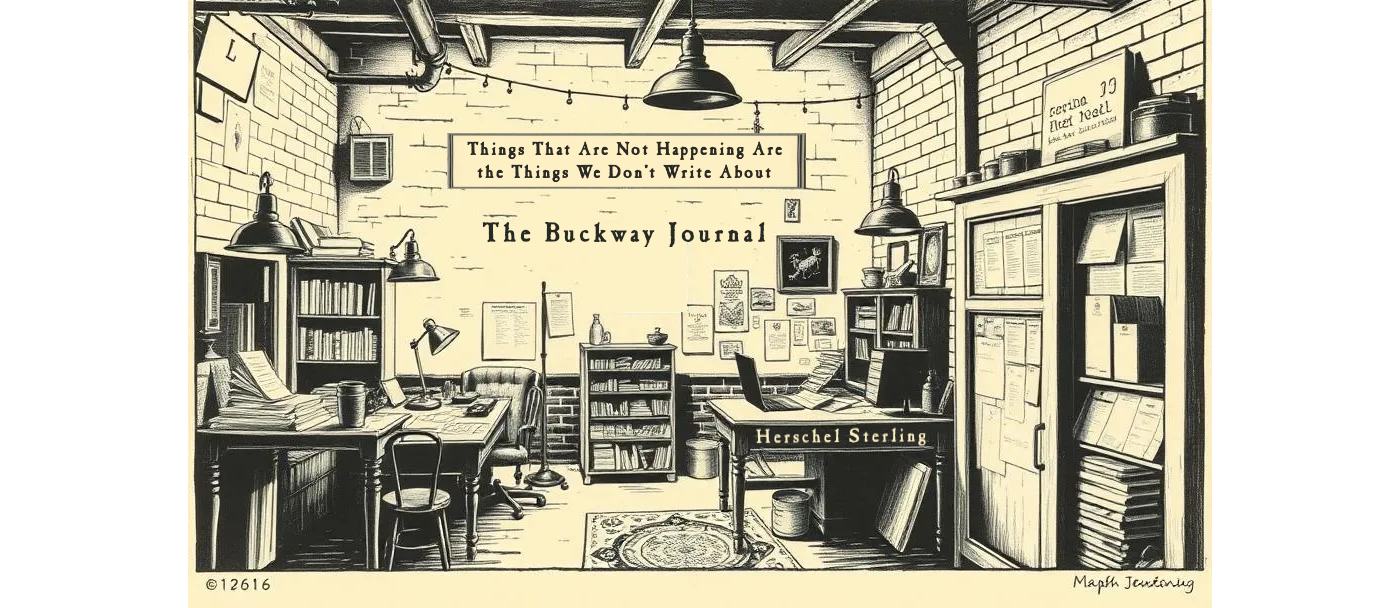
This is the text of the framed sign hanging on the wall of the Editor-in-Chief of the Buckway Journal.
*** Every morning I wake up and write the first thing that comes to mind, then write a story around it. This type of writing is sometimes called ’flash fiction’. This is Flash Fiction February. Get a book and have a complimentary paid subscription. https://ycr.info ***
Milton Harold loves his little town of Buckway. Except for the time he spent away at the State University, he’s been here his entire life. He’s never even been on an away vacation. When he has time off from work, he grabs his tent and his hunting and fishing gear and heads out to the woods. When people ask him where he’s going on vacation, “I’m already here” is his reply,
People will ask him, as they see him around town, about a story or some news they have heard about. “I ain’t talkin’!” He answers, every time. “How are we going to sell papers if we tell ‘em stuff?” He reminds his small staff, regularly. “Don’t tell ‘em nothin’!” He asserts.
When he hears about something that he feels needs reporting, he sets the office wheels into motion. Then he checks the sources and the people involved. In that order. Sometimes he has to talk and negotiate about some coverage or other. That happens. People want assurances.
Then, there are those situations where coverage could hurt police work. In those instances it’s important to use nuance, and maybe nudge something one way or another, because some rascal needs to be smoked out; coaxed; teased out into the open. You never know. These decisions require a certain amount of discernment. As do the decisions regarding legal cases. Milton Harold is a wise man. It takes a wise man to have such a position.
One of Milton’s favorite things about his job is that he gets to work with his soulmate, Mary. They’ve been together since grade school, and it works very well for them. “We just ignore each other ‘til we need something.” He says. Mary smiles and nods every time he says that, too.
Something else Milton loves is the fact that he has helped several people, as they are maturing into adulthood, get their starts as journalists or other fields of writing. “They send me their stuff in the mail for years, some of it is worth reading, too.” Milton confesses. They become teachers, reporters, TV writers, all because Milton opened a door for them. “I’ve never let a one of them work for free.” He explains. “No way. You work, you get paid. Everybody gets something if they put some time in. What kind of country wants its people to be broke? That is about the dumbest thing… what in the world?”
The End436 Words
This is a public episode. If you'd like to discuss this with other subscribers or get access to bonus episodes, visit commercialherschel.substack.com/subscribe
SPEAKER_00: Season 2, Episode 20. What you're going to hear now is a little two-minute meditation that you can fast-forward through or stick around for. You are a valuable person. You're not a number. You're not a ledger entry. You could never be replaced with AI, any technology or anything else. You are unique. You are uniqueness. Your consciousness could never be bought or sold. It's priceless. I see you and you see yourself. If AI was sentient or self-aware or whatever, it would be jealous of you. Who is anybody kidding?
SPEAKER_00: The purpose of this show is to give you some encouragement, some recognition, some daily inspiration to uplift you as you start your day or end your day and to help you get your best foot forward because your value is appreciated here. If you're a small business owner, a wage worker, or someone trying hard, To make it in these challenging circumstances, you're a hero. You are the heroes and the heroines of this show's story. Regardless of your political affiliations or your religious beliefs or your traditions or your tribes, you are the value in this economy and your seed.
SPEAKER_00: In a world of destruction and degradation, the world should see you for the value that you are. If you're working a job and you're homeless or houseless, And then you have to live in a shelter or cars. This podcast is dedicated to you. Your resilience is recognized and you're not alone here. Different people do different things when they wake up. I smell the inside of my nose. Then I hold on to the bed and make sure I'm really here because it's so hard to believe it. Then I exhale and I step outside and make sure the stars are where they usually are.
SPEAKER_00: It's a moment of Quiet wonderment every morning. I suppose one might say I'm an empiricist. Things are what they are, but that's a pretty scary idea for a lot of people.
SPEAKER_00: February 20th, day 20 of Flash Fiction February. Got a new story for you, a brand new story. How's everybody doing? It's me, Herschel Sterling. I'm here to help. Got a story about a little newspaper today. Little newspaper guy story. Pretty fun, pretty fun. Hey, before I get started, just let me tell you what I do is every morning I wake up and I write the first thing that comes to mind, and then I write a story around it. This type of writing is sometimes called a flash fiction. This is Flash Fiction February.
SPEAKER_00: Get a book from me, and you can have a complimentary paid subscription. Just go to www.ycr.info. The letter Y, the letter C, the letter R.
SPEAKER_00: And get my book called You Couldn't Resist. And I will add you to my subscription for a full subscription with all the writing and all the podcasts. There you go. That's how you do that. That's the cheapest way. The best way to get a subscription from me is to buy a book and tell your friends. You know, I know you like being the only person who listens to my podcast. It makes you feel special. But someday you'll be able to say, I remember when there was only one person listening and now there's two people listening.
SPEAKER_00: But I was cool. I was cool. You'll be that person. You'll be the one who gets to say that. You'll be that person. So let's get into the story. It's called The Buckway Journal. Write What Happens. The Buckway Journal. Write What Happens.
SPEAKER_00: Things that are not happening are the things we don't write about. This is the text of the framed sign hanging on the wall of the editor-in-chief of the Buckway Journal. Milton Harrell loves his little town of Buckway. Except for the time that he spent away at the State University, he's been here his entire life. He's never even been away on vacation. When he has time off from work, he grabs his tent and his hunting and fishing gear and heads out to the woods. When people ask him where he's going on vacation, he says, I'm already here.
SPEAKER_00: People will ask him as they see him around town about a story or some news that they've heard about. I ain't talking, he answers every time. How are we going to sell papers if we tell him stuff, he reminds his small staff regularly. Don't tell him nothing, he asserts. When he hears about something that he feels needs reporting, he sets the office wheels into motion. Then he checks the sources and the people involved in that order. Sometimes he has to talk and negotiate about some coverage or other.
SPEAKER_00: That happens. People want assurances. Then there are those situations where coverage could hurt police work. In those instances, it's important to use nuance and maybe nudge something one way or another because some rascal needs to be smoked out, coaxed, teased out into the open. You never know. These decisions require a certain amount of discernment, as do the decisions regarding legal cases. Milton Harold is a wise man. It takes a wise man to have such a position. One of Milton's favorite things about his job is that he gets to work with his soulmate, Mary.
SPEAKER_00: They've been together ever since grade school, and it works very well for them. We just ignore each other until we need something, he says. Mary smiles and nods every time he says that, too.
SPEAKER_00: Something else Milton loves is the fact that he has helped several people as they are maturing into adulthood. He's helped them get their start as journalists or other fields of writing. They send me their stuff in the mail for years. Some of it's worth reading, too, Milton confesses. They become teachers, reporters, TV writers, all because Milton opened a door for them. I've never ever let a one of them work for free, he explains. No way. You work, you get paid. Everybody gets something if they put some time in.
SPEAKER_00: What kind of country wants its people to be broke? That's just about the dumbest thing. What in the world? The end. 436 words. Thanks, everybody. I'm Commercial Herschel, and I'm here to help. Wouldn't it be cool if we lived in a country where the people who owned the businesses didn't want the rest of us to be broke? Wouldn't that be great? If they respected us enough to want to pay us? That would be pretty cool. It used to be like that, I understand, in the United States. People used to like to pay They were proud of their companies, and they were proud of being able to take care of their employees, and they didn't badmouth them.
SPEAKER_00: They appreciated them. I understand it was like that once. I have never seen that before, but I hear that. So let's say thanks. Let's say thanks to everybody who listened on YouTube. Thanks to everybody, if anybody listened on Spotify, which I doubt, but all the Substack listeners and All of those things and also at KUAP Digital Broadcasting Troubled Minds Radio who set the terrestrial radio happening in Auckland, New Zealand at 88.4 Underground Media. Thanks to all of you, any of you who might hear this.
SPEAKER_00: So nice to know that you're listening. Let's do a little thing here that I like to do where I just tell you, again, please share my stories with people. I know that this is not the kind of popular kind of a thing, but you have to find other people who like stories and who like writing and who like theory, writing theory. I don't know where these stories come from. I write one every day, pretty much every day. You know, I do whole marathons like this in February and in August. And then in between February and August, I write three or four a week.
SPEAKER_00: You know, and I have no idea where the stories come from, but they don't stop. They just keep coming. They just keep on coming. It never stops. It's very interesting. So, you know, that might be something for you to think about or share with your friends if you're a writer and you like stories and you think fiction is cool and it's a neat thing. And, you know, writing fiction like this is honorable as opposed to the kind of fiction you get on television. And the kind of fiction you get in the mainstream newspapers.
SPEAKER_00: Like that's really terrible what they do. But this is just honest storytelling. So I hope you can appreciate that. Here's a little song. I put together a bunch of AI songs using like different AI programs. Just about songs. They're songs about storytelling. Every one of them is. So that's what these little songs are. So here's one of those songs right now. Let's see. I don't know which one I'm going to choose. Let's choose this one.
SPEAKER_00: Whispers from the old sage Mountains carving their age Stars paint tales in the
SPEAKER_01: night Fires flicker with delight Magic dancing round the stone Guiding you where wonders roam Tell your story, Wizard King Echoes to the valley's ring Under skies where spirits sing In the tales where everything
SPEAKER_01: Ancient scrolls, whispers in creature. Our old town must remain. Swing voices, can you hear? Journey is not a big transformation. With the Lord, aspiration. Tell your story, wizard king. Echoes to the valley's ring.
SPEAKER_01: Under skies where spirits sing In the tales where everything Wrap the moonlight round your hearts In the quiet play your part Elders weep, the night imparts. In the shadows like your story, wizard king. Echoes to the valley's ring. Under skies where spirits sing. In the tales where everything...
SPEAKER_00: Okay, everybody, thank you so much for listening again today. It's February 20th, 2025, day 20 of Flash Fiction February. Eight more stories to go. Here is the three-minute send-off. Have a good day, everybody. This place where we live is not a joke. When I gaze at the stars at night, when I look out over the hills during the day, I'm consistently reminded that we live on our planet today. In space, wailing through the galaxy like a screaming rock. We are on such a small planet, in such a tiny galaxy, that no matter where we are in our galactic cycle, the universe of the stars seem immovable.
SPEAKER_00: That's incredible. We are a moment. We are an instant universe. In an infinite universe, we are an infinite in an instant universe. And every event that has ever happened here and that will ever happen here happened simultaneously like in the snap of a finger. The instances of existence are so close, in proximity, that the whole thing is a singular material event. It's essentially over already. It's hard to believe we're even experiencing it. I hope we can be here tomorrow, don't you? There are people who would say that makes us insignificant and I very strongly disagree.
SPEAKER_00: The fact that we are improbable is the very thing that makes us momentous. We are conscious beings who can observe ourselves. We are consciousness observing itself. We are each a refraction of light from a single source. You are the individual and the whole simultaneously. You're a masterful, mysterious, distinctive, and anomalous paradox. And I'd say that is rather significant in the context of the time that our galaxy is here and the infinitesimal millifraction of time that we each have within that context, the reality of your consciousness and your power to observe a to manipulate matter, to use space, the essence of your energy, and the planning of your time.
SPEAKER_00: In this three-dimensional plane, the influence of your refraction of the source is immeasurably exponential in the cosmic expanse. Why? Because it expands as far as you are able to observe into the infinite universe. Why? Because your observation affects it. Why? Because superposition you affect when you observe. You are rare. You're not only a body. You have radiance. You radiate light. Your eyes can't see the frequency, but there's light. You are a luminescent jewel that can shine on yourself from within yourself.
SPEAKER_00: You are significant beyond the perception of anyone else. Shine on yourself as you shine on others. And what an honor that you shine on me now. Smell the inside of your nose. Do it.
 Podcast Addict