What if "Terms of Service" was FUN!
Tonight's Episode
Hello new followers or subscribers Adnan Hasan and Paul Edward
I have had a lot of fun with building community sites and learning some essential PHP, all sorts of open source software, migrating data, SQL, and a few other database types, like CRM’s and whatnot. There are differences between servers, sometimes a static type service is fine, and sometimes you want a media server. When I was understanding this stuff, real-time communication through a web interface could require any number of server types, one of them was RTMFP. Maybe it still does, I don’t know. I know that was a big deal when I graduated to making those decisions. None of these things became any kind of income producers, but they were fun and it’s all a very interesting process and world.
Deconstructing your Terms of Service and Privacy Policies
I will make you WANT to read the Terms of Service and Privacy on Websites.
In this time of media reconfiguration, and the fact that Americans seem to be moving toward maintaining their First Amendment Rights in the face of the absurd onslaught of puerile behavior from internet distribution systems, here is a solution to some things that will help people actually WANT to read the TOS, Privacy, and other legal statements regarding the websites they use. We can’t expect the outlets to be honest, but we can use honesty to out maneuver them.
It falls in line with the ideas from past episodes about knowing what we don’t want. It’s more deconstructing and removing verbiage that is unnecessary for conceptual thought. Knowing what we don’t want is usually more important than knowing what we do want. Omitting the unnecessary and unclear is a recipe for a clear and confident mindset.
How often have you actually read the Terms of Service (TOS), or Privacy policies on websites, services and social media that you use? It’s so boring and tedious, right? What if there is a way to make it simple to decode and likely for you to check them out? What if it was interesting enough to make you WANT to check them out.
I had a dream once, a vision, I wanted to do something, so, I tried. I was (am) entrepreneurial and I made a couple of huge mistakes in 2009, embarrassing mistakes building a social media site. It was a lot of really hard, and wasted work. But, I learned. It didn’t even have anything to do with the topic of this blog post, and maybe I’ll write about that some day. If you want to know about the big mistakes I made, and don’t want to repeat those mistakes so you have a better chance at being successful, well, that would cost you. That was an expensive lesson and I still need to recoup from that. Unless you want to pay me to tell you that stuff, then you can suffer like I did. It’s one of those “Damn, if I knew then what I know now” things. I’ll tell you, but it will cost you.
In the process of that monumental “failure” I learned some very valuable things, and one of the things was how I came up with presenting TOS and Privacy policies, and that’s what I’m going to explain here.
I have this problem where I really like to dive in and understand things. It came down to the point where I had to come up with the TOS and privacy for this kind of niche social media type site I made. I had to really think through it and have it come out as simple as I could make it. I didn’t want it to be long and complicated, and I wanted to make sure people knew what they were getting into.
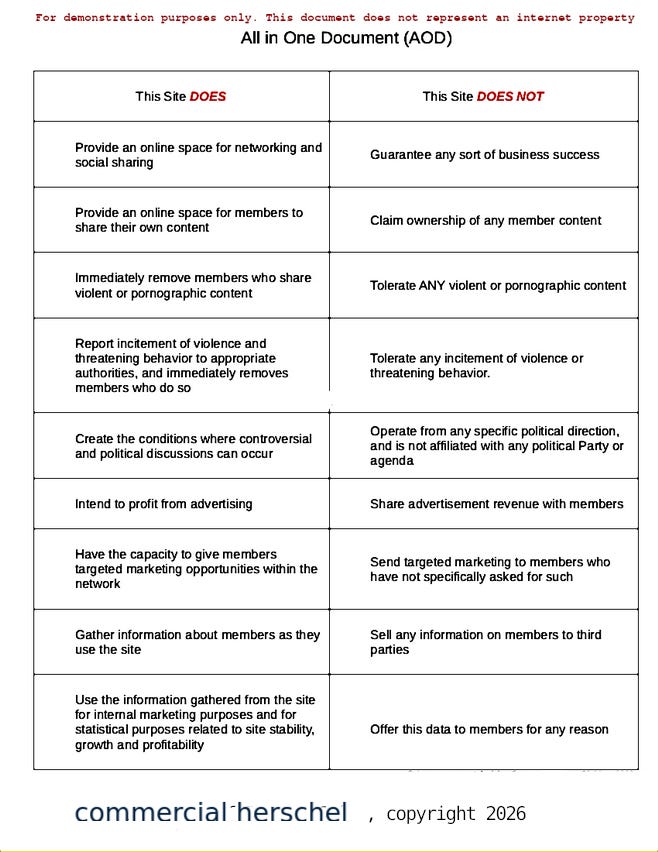
The way I went about doing that was to begin making a list of what the site does do, and what it does not do. Then what happened is I realized that what I was creating was a Site Description, Terms of Service, and a Privacy Policy Statement all at the same time. It was an interesting thing that happened by accident as I was describing the site to myself in preparation to describing it to others.
I call this The All in One Document © I am your new television OK? You can stop thinking, 2026. Bear in mind that the example I’m showing you is a small sample of what would actually be needed to truly fill out a proper site description. I really only want to spend enough time to make the points I learned from the process and to convey it.
I think you’ll see that it’s the kind of thing that can be adjusted for whatever type of site someone is making, and eventually, if put into wide practice could result in categories that are easily understood, and will even be interesting for the site users to read the TOS and Privacy Policies. Can you imagine these policies being interesting? I first came up with this in 2009, I revisited it in 2019, and now I’m presenting it to you here.
Some of you are going to want to argue about what the policies are, and miss the point of the post. You are welcome to argue about the policies of a fictional website. At least using this kind of approach, you can actually tell what the policies are before you chime in about your opinions about what someone else is supposed to do with their service. Now you can actually have that discussion and enjoy the process, and consider your rights and responsibilities. You’re welcome.
In the left column, it says what the site does, and in the right it simply states what it does not engage in.
See what I did there? As you go through it, you realize that you’re getting a Site Description, Terms of Service, and Privacy Policies simultaneously Or, The All in One Document ©. I’m showing you a simplified version, but for some sites that would be enough. It does not have to be super complicated.
Other things that would happen are links within each of the table fields where there is expounding on the issue addressed. Eventually, simple, unified icons can begin to represent concepts, similar to content attribution icons. Icons are the Universal Language of the Internet (ULI). You will be able to go through it and just see the iconography. Then what will happen next is that sites will fall into certain categories, or, their AOD category. As there are ratings for movies, and age restrictions for events, there will be a categorization of sites and it will be something you learn easily.
One of the lessons learned from this is from the cliche of “there is no such thing as failure” because even though I didn’t achieve my stated goals in that site endeavor, I still learned some valuable lessons that should be worth something to someone, and I stumbled into ideas that will be useful in future attempts. This thing I just showed you is just what I’m showing you. What I’m not showing you is like a chocolate fountain, only maybe molten gold.
Entrepreneurial, first-amendment, fourth-amendment, Privacy, social-networks, Terms-of-Service, TOS, Twitter, websites, ecommerce website, new technology, seo, marketing research, video, legal terms, acceptable use policy, terms of use generator, terms and services, website terms and conditions, snapchat terms of service, term of delivery, website terms of use, terms of use and privacy policy, terms of service and privacy policy, privacy policy terms of service, contract payment terms, terms of payment in a contract, terms and conditions sample text, terms of service agreement, payment terms and conditions
This is a public episode. If you'd like to discuss this with other subscribers or get access to bonus episodes, visit commercialherschel.substack.com/subscribe
We are valuable people. We're not numbers. We're not ledger entries. We could never be replaced with AI or any technology or anything else. We are unique. We are uniqueness. Our consciousness could never be bought or sold. It is priceless. We see each other. I see myself. You see yourself. We look at each other. Who is anybody kidding here? The purpose of this show is to give you some encouragement and some recognition. Maybe some daily inspiration to uplift you as you start your day or to end your day as it turns out many of you listen to me in the evening.
And to help you get your best foot forward because your value is appreciated here. If you're a small business owner, a wage worker, someone trying hard to make it in these challenging circumstances, you're a hero. You're the heroes and the heroines of this show's story. Out there doing this every day in spite of the best efforts of the people who want to destroy us. I'm grateful for you, regardless of your political affiliations or your religious beliefs or your traditions or your tribes. You're the value in this economy and you're seen.
in a world of destruction and degradation. The world should see you for the value that you create. If you're working a job and you're homeless or houseless and you have to live in shelters or cars, this podcast is dedicated to you especially. Your resilience is recognized here and you're not alone. You are really not alone here. Different people do different things when they wake up in the morning. I, of course, smell the inside of my nose first. Then I hold onto the bed and make sure I'm really here because it's so hard to believe it.
Then I exhale and I step outside and make sure the stars are still where they usually are. It's a moment of quiet, anxious wonderment every morning. And I suppose one might say I'm an empiricist. Things are what they really are. And that's pretty scary for a lot of people. I hope this isn't a scary podcast for you. I'm Commercial Herschel. I'm here to help. This is going to be an interesting one this morning. I'm going to talk about the terms of service on websites and a different way to think about terms of service.
And I bet you by the time I'm done with you in this podcast, reading terms of service is actually going to be something interesting for you to think about rather than something to just forget about and gloss over. So let's do a fake ad right here. Fake ad right here. As I said, I am Commercial Herschel and I am here to help. And you can find me just by searching online. Smell the inside of your nose. Do it right now. You can search for Commercial Herschel. You can subscribe to my substack for free or you can pay me if you want.
You can buy me a coffee at buymeacoffee.com forward slash smellcast. You can donate cryptocurrency to me. There's a site, there's a page at my substack where you can see those links if you want to throw some cryptocurrency my way. You can watch me on Rumble, you can watch me on HowTube, you can watch me on BitChute. Just do a search for Commercial Herschel or Herschel Sterling or smell the inside of your nose and you will find it. You can also find my stacker.news site at stacker.news forward slash herschel on all the web3 apps like Nostr, like stacker, like blogstack, like any of them.
I am at Herschel. That's my handle. That's where you'll find me at Web3. Okay, so let's get into this thing of websites and the terms of service. This will be really interesting. You wish that you had read the terms of service, but you don't wish you read them at the same time. It's like you wish you read them and then you're glad you didn't read them. Let's deconstruct the Terms of Service in a way. And we're going to have a lot of fun. By the time I'm done, I think I can make you want to read Terms of Service if they were written a different way.
If they were done a different way and presented in a different manner than they are currently presented, you would not only want to read them, you might actually get enjoyment out of them. And I know that sounds crazy, but I am weird, and that's just how this is. So you're going to probably want to actually go to my website, go to my substack, and see the documentation that I put on there so you can see the image that I used to describe this. But I'm going to do my best to articulate it without the image, okay?
In this time of media reconfiguration and the fact that Americans seem to be moving toward maintaining their First Amendment rights in the face of the absurd onslaught of puerile and dishonest behavior from internet distribution systems, here is a solution to some things that will help people actually want the Privacy and the other legal statements regarding the websites that we use. We can't expect the outlets to be honest but we can use honesty to outmaneuver them. It falls in line with the ideas from some of my past episodes where I talk about knowing what we don't want and how sometimes knowing what you don't want is more important than knowing what you do want.
So you're deconstructing Verbiage and you're removing verbiage that is unnecessary for conceptual thought. Concepts don't require as many words. Sometimes concepts only require pictures and icons and you don't even have to write out a sentence. You can just show somebody in a picture. So knowing what we don't want is actually and usually more important than knowing what we do want. Remember what I said in that one episode when you're a kid you kind of know earlier in life what you don't want to be in life than you do want.
Like you might know what you want to do when you grow up, but you haven't really figured out how you want to be. Like those things aren't totally in place yet, but you see the behavior of certain adults and you say, yeah, I'm not going to be that. So what you don't want is actually very often more important than what you do want. So omitting the unnecessary and unclear is a recipe for a clear and confident mindset when you go forward into something. How often have you actually read the terms of service or the privacy policies on websites, services, and social media?
It's so boring and it's tedious, right? What if there was a way to make it simple to decode and likely for you to check it out and to know what you're getting into? What if it's interesting enough to make you want to check it out? I think I'm going to show you that. That's just my opinion. I could be wrong. It could be boring no matter what. I had a dream once, a vision. I wanted to do something, so I tried. I am entrepreneurial and I made a couple of huge mistakes in 2019. or excuse me in 2009 embarrassing mistakes building a social media site it was a little niche site and it was a lot of really hard work and wasted work because I did things in the wrong order but I learned from that and it didn't even have anything to do with the topic of this podcast or this blog post and maybe I will write about that someday So if you want to know about the big mistakes I made and don't want to repeat those mistakes so that you have a better chance of being successful, that is something that would cost you.
That was an expensive lesson. And I still need to recoup from that lesson. So, unless you want to pay me to tell you that stuff, you can just suffer through it like I did. It's just one of those, if I knew then what I know now, things. I could tell you, but that would cost you. But, in the process of that momentous failure, that monumental failure, I learned some very valuable things. And one of the things was how I came up with presenting the terms of service and privacy policies. And that's what I want to explain here.
I think it's really cool and interesting and it's a really great thought experiment and that's kind of what this podcast is all about. It's all about thought experiments and if you're just listening to this before you go to bed and you're in the business of tech, I hope you listen to this before you go to sleep and have some like good sleeping on this and then wake up in the morning with some good thoughts because I would like to hear them. I would like to hear your thoughts about this. And, you know, if you're listening to it in the morning when you're waking up, I'm sure that it'll give you some cool things to think about throughout the course of the day.
Especially if you're in this world, in the legal world or in the tech world. That would be really cool. I would love to hear from some lawyers on this. I have this problem where I really like to dive in and understand it. It came down to the point where I had to come up with the terms of service and privacy for a kind of niche social media type site that I made. And I had to really think through it. And I wanted it to come out as simple as I could make it. I didn't want it to be long and complicated.
And I wanted to make sure people knew exactly what they were getting into when they came onto my site. I just feel like that is like the honest way to be. You just want people to know what's real and what's not. real and what your site does and what it doesn't do but that's just kind of what you want you want you're looking for the right kind of people so you want to advertise to them and i think the terms of service should be a form in a way a form of advertisement in a way So the way I went about doing this was to begin making a list of what the site does do and making a list of what it does not do.
Remember, make a list of the things you do not want. Then what happened is I realized I was creating a site description, a terms of service, and a privacy policy statement all at the same time, all in one document. And it was an interesting thing that happened by accident as I was describing this site to myself in preparation for describing it to others. So I'm getting ready to make this site description and privacy policies in terms of service. So I was first, well I better describe this site to myself and in the process of doing that I came up with this cool thing and I call it the all-in-one document.
and I named it after the blog I had at the time. It was I Am Your New Television. You Can Stop Thinking Now. That was the name of my blog back then. And I call this the all-in-one document from I Am Your Television. You Can Stop Thinking Now. Bear in mind, well I should clarify that, it says I am your new television, okay? You can stop thinking. I am your new television, you can stop thinking. Okay, I'm just saying. I gotta be, for accuracy's sake, I should make sure because that's important. Okay, so I call it the all-in-one document.
Bear in mind that the example I'm showing you in the blog post for you people listening is a small sample of what could actually be needed to truly fill out a proper site description in terms of service. I really only want to spend enough time to make the points I learned from the process and to convey it. I think you'll see that it's the kind of thing that can be adjusted for whatever type of site somebody is making and eventually, if put into wide practice, could result in categories that are easily understood and will even be interesting for the site users to read.
Can you imagine these policies being interesting? And I first came up with this in 2009, I revisited it in 2019, and now I am presenting it to you here in 2024. So, some of you are going to want to argue about what the policies are. If you're doing that, you're missing the point of the post. You're welcome to argue about the policies of a fictional website that does not exist. At least, using this kind of approach, You can actually tell what the policies are before you chime in about your opinions about what someone else is supposed to do with their service.
now you can actually have that discussion and enjoy the process and consider your rights and responsibilities and you're welcome so let's take a look at this thing there's the document right there up on your screen if you're on my website if you're on my sub stack you can see it it says for demonstration purposes only this document does not represent an internet property the all-in-one document AOD I am your new television okay you can stop thinking now There's two columns. On the left side the column says this site does, on the right side it says this site does not.
And you can just deconstruct your website and come up with these two columns and you'll find yourself omitting and removing things more and more and more over time because they're redundant and you can actually fit all three, your site description, your privacy policies and your terms of service all in one columnated document. The left column says this site does, the right column says this site does not. So let's read it for fun. This site does provide an online space for networking and social sharing.
This site does not guarantee any sort of business success. This site does provide an online space for members to share their own content. This site does not claim ownership of any member content. This site does immediately remove members who share violent or pornographic content. This site does not tolerate any violent or pornographic content. This site does report incitement of violence and threatening behavior to appropriate authorities and immediately removes members who do those things. This site does not tolerate any incitement of violence or threatening behavior.
This site does create the conditions where controversial and political discussions can occur. This site does not operate from any specific political direction and is not affiliated with any political party or agenda. This site does intend to profit from advertising. This site does not share advertisement revenue with members. This site does have the capacity to give members targeted marketing opportunities within The Network. This site does not send targeted marketing to members who have not specifically asked for such.
This site does gather information about members as they use the site. This site does not sell any information on members to third parties. This site does use the information gathered from the site for internal marketing purposes and for statistical purposes related to the site stability and growth and profitability. This site does not offer any data about members to other members for any reason. That's like this fake website that doesn't exist that almost existed but that does not exist and that was basically the site description the terms of service and the privacy policies almost all of it in one simple form that anybody could read.
And they would probably be longer than that in real life, but that was actually kind of interesting to read. So in the left column, it says what the site does. In the right column, it simply states what it doesn't engage in. You see what I did? As you go through it, you realize you're getting the site description, the terms of service, and the privacy policies all at the same time. What you see here is a simplified version, but for some sites, that would be enough, and it really would not have to be super complicated.
Other things that would happen are links within each of the table fields in the column. So each column has a table. In the table fields, you could expound on a concept in there. If somebody wanted to click off onto it, they could just click it and it would open up in a new box and they could read that. Eventually, simple unified icons would take over in some ways. Like people could just look at the iconography and they would know what kind of a site it was and what the policies were. because icons represent concepts similar to content attribution icons.
Icons are the universal language of the internet. You'll be able to go through it and just see the iconography. And then what will happen after that is sites will fall into certain categories or their AOD category, their all-in-one document category, just like there's ratings for movies or age restrictions for events or, you know, whatever kind of a type of a product or a service. There would be a categorization for that and you will understand essentially what it is that you're getting into by engaging with that site.
Alright, and so there would be like a, not a rating and not something that is controlled externally, but just so that you understand what it is you're getting into with that site in terms of their privacy issues. So just like a rating for movies or You Will WANT to Read the Terms of Service
They accept advertising, they don't sell my information, and they do gather data. Okay, now you know that just by looking at those pictures. So that would be something that would just take a little bit of time for us to learn about the internet. And using this method of having a column nated, this site does, this site does not, moves us in the direction of doing that. So one of the lessons learned from this is from that cliche, there's no such thing as failure. Because even though I didn't achieve my goals in that site endeavor for that website I was building, I still learned some incredible, valuable, and maybe invaluable lessons that should be worth something to people.
And I stumbled into ideas that will be useful in future attempts. This thing that I just showed you, It's just what I'm showing you. What I'm not showing you is like a chocolate fountain, but it's maybe made out of molten gold instead. There's a lot of information that is learned from failing and it's worth something. And this all-in-one document is just one thing that I learned. It's one thing I figured out over time, you know, just because we all have different ways of thinking about things and this is my way of Commercial Herschel
that it's a bad idea. And so if you have any questions or comments or you're interested in this concept or you want to talk to me more about what I learned in my social media endeavors, you can reach me at CommercialHerschel at Proton.me and I will contact you privately. Or if you're interested in this all-in-one document and maybe your company or publishing company or your law firm wants to purchase this concept, for Commercial Herschel
in my failure. You're welcome to do that and I'll make it as easy on you as I can. I promise. So there you go. There is that. So let's just do a little thing right here where I just put a fake ad up. We'll come back and I'll ask you the question of the day and then we'll go on our merry way starting off with the daily send-off which is the same every day only different mark. Fake ad right here. Here is my question for you. But first, thanks so much for listening. I've been having a riot with this podcast.
I'm trying to stop talking about the podcast during the podcast, you know, because I'm enjoying the process so much. And I just, I like to overthink things. And it's just been such a stimulating time. And I'm really glad it's growing. I'm glad people seem to be every day I seem to get more downloads than the day before. And I get I seem to have more subscribers and more regular listeners, and I'm just thankful for you for that. So thank you. Thank you, you 25 people every day who listen to my podcast.
I appreciate you. That's the average number of people who listen to my podcast every day is 25. And after three weeks, my podcast had 840 views and downloads. And after just one more week, it had over 12
1281 I think and at 1281 or something after four weeks and so now we're into the fifth week And I'm kind of in a different mode because I'm not online as much, but I'm doing one podcast per day I'm recording one podcast per day and I'm putting a new one out every other day. Then eventually, once I'm back online all the time again, I'm going to catch up and start doing them every day again. By the time it's done, there's going to be a lot of them. Here's the question of the day. Let's think of a good question of the day.
If you had a simple way of reading the terms of service, the privacy policy, the site descriptions, all of those legal things, If you had a simple way to understand them since the beginning of the internet, how do you think things would have been different? How do you think the internet would have gone differently if people could have a simple site iconography to explain to them what their websites that they visit are doing with their data and what they have the right to do with their data? You know me, if you listen to my podcast, you know that I don't appreciate these sites who censor people under the false notion that they're doing it out of some kind of a good moral position.
Because we know that they remove good information and they call it bad information only because it interferes with their profit margins and what their advertisers want them to do. Not because it's honest, not because it's good or bad or honest or accurate or inaccurate. It's all purely based in profit and what they want you to be able to know and thankfully the free market has created the space for people who believe in the first amendment to continue to communicate with each other despite the best efforts of these big companies that control our internet.
So what do you think? Do you think that this would have all turned out differently if there was a simple iconography and a simple list on one side that says this is what this site is and what it does do and this is what this site is not and what it does not do and then maybe some simple little pictures to go along with it. What do you think? Do you think things would have turned out differently for us all these years later? And when you think about it, it's only been 30 years that we've had internet and really only You Will WANT to Read the Terms of Service
Alright, what have we learned as a society about our first amendment rights and about what is and what is not allowed on the internet and our fourth amendment rights and our privacy and all? What have we learned? And how can an idea like the one I put in this blog post, in this podcast, how can this idea help? How can it help? Does it help? Is it worse? Does it make everything worse? I don't know. I don't think so. Okay, so cool. Let's go into the send-off. I read it every day. It's really long, but it's the same every day, only different.
It's not really long. It's like two minutes, maybe three, and it really helps keep me in a good mood and keep my, keep me going forward. This place where we live is not a joke. When I gaze at the stars at night, when I look out over the hills during the day, I'm consistently reminded that we live on a planet in space, wailing through the galaxy like a screaming rock. We are on such a small, small planet in such a tiny, tiny galaxy that no matter where we are in our galactic cycle, the universe of stars seem immovable.
That's incredible. We're a moment. We're just a little moment, a little instant in an infinite universe. We're an infinite in an instant universe. Every event that's ever happened here and that will ever happen here happened simultaneously in the snap of a finger. The instances of existence are so close in proximity that the whole thing is a singular material event it's essentially over already and it's hard to believe that we're even experiencing it I really hope we can be here again tomorrow war mongers jackasses there are people who would say that all of that makes us insignificant I very strongly disagree with them the fact that we are such improbable creatures is the very thing that makes us momentous We are conscious beings who can observe ourselves.
We are consciousness observing itself. You are each a refraction of light from a single source. You are the individual and the whole simultaneously. You are a masterful, mysterious, distinctive, and anomalous paradox, and I'd say that that is rather significant. In the context of the time that our galaxy is here, an infinitesimal, millifraction of time that we each have within that context, the reality of your consciousness and your power to observe and manipulate matter, to use space, the essence of your energy and your planning and time usage, In this three-dimensional plane, the influence of you and the refraction that you bring is immeasurably exponential in the cosmic expanse.
It really is because it expands as far as you're able to observe and reach with your observation into the infinite universe because your observation affects it. Your observation affects what you look at. That's superposition. You are rare. You're not only a body, you have radiance. You radiate. Your eyes can't see the frequency but there's a light coming off of you. You're a luminescent jewel and you can shine on yourself from within yourself. You're significant beyond the perception of anybody else.
You shine on yourself. while you shine on other people. And what an honor that you shine on me. So smell the inside of your nose. Do it right now.
 Podcast Addict